Tuesday, October 5, 2010

Back in the Great Rainy North

Back in the Great Rainy North (people may not complain about Seattle weather in my presence ever again). I’m getting into the swing of egging on community projects again, but was decidedly grumpy my first few days back because, among other things: my gas tank ran out the night I got back so I had to return to the city immediately to get more; I evacuated 19 spiders from my house; a rat moved into my house in my absence, and since I had prudently left no food out, had some fun munching on my soap; some of the neighbors, apparently having decided that I had moved out, went back to posting their cows in their yard, knocking holes in my fence to do so; the cows knocked more holes in my fence; the neighbors got a new pig who got loose my first day back and went galloping though my yard and—wait for it—through my fence, creating another hole, in order to investigate my compost pile; and it rained off and on for 6 days after I got back.

Lovely.

I grumbled to myself for a few days and silently fumed at people for demanding gifts (if you’re rich enough to go to the capital, you’re rich enough to bring presents back for everyone you have ever met, I guess). Then I reluctantly got up the energy to mend the fence, hire my first helper to mow my overgrown yard (with a machete and 6 children), and—do I want to admit this? OK—invent a new game I like to call Rat Bowling.

I usually retreat under my mosquito net at about 7pm to read with my solar light, listen to podcasts, and (when I have battery) watch movies on my recently-arrived netbook. The rat starts getting active about 8, and once it gets cheekily noisy, I retaliate from the safe perch of a chair in the doorway by sliding or rolling objects across my kitchen floor to slam up against whatever it’s hiding behind. Noise in the shelves? There goes the inflatable beach ball (Thanks for the gift, Kas!) Rustling behind the buckets? Bam! Goes my laundry detergent. You think my work basket will provide coverage? This lofted bottle of ibuprofen says no.

I guess I hoped this would be a humane way of evicting the annoying not-so-little animal, but it’s also entertaining. Alas, no sign of it vacating, so I’ll be looking for a rat trap this afternoon. Some animals I do not live in harmony with—cockroaches and rats are among them.

Anyway, other than that, things in my town are pretty much the same. One of the neighbors has yet to fix the roof of his (outdoor) kitchen, which caved in two months ago. About half a dozen babies were born in my almost-monthlong absence—yes, just in my little 1000+ person town. Most will be loved well, clothed and nourished poorly, get an elementary-level education, and lose a few teeth by their mid-20s.

At some point in the last few months it must have gotten around that I was a minor expert in foreign currency, because 3 or 4 people have stopped by to have me look at money from abroad—a lot of the clothing here is shipped second-hand from developed countries, and people find random items from abroad in the pockets pretty frequently. In the last few months I’ve been asked to look at and explain paper money from Korea and China and an old-style lira coin from Italy. Two days ago a toothless old man wandered into my kitchen, plopped down in a chair, and pulled out some19th-century French coins, one of which was from 1854 and had the picture of Bonaparte III on it. I’m a bit of a coin collector myself, so I was tempted to make an offer for it, but I have no idea what a fair price would be and anyway, he said he had inherited them from his grandfather. Judging by his age, I think the coins were brand-spanking new when his granddad got them.

I have no idea why he was showing them to me—perhaps he thought they would make me feel at home. People still think I’m French even after I tell them I’m American. Despite peoples’ fascination with “the foreigner”, they neglect the basics to an astonishing degree. I’ve done the introduction of where I’m from to my English club several times, and even THEY think I’m French. You’d think my crappy French would tip them off. I keep having people stop by to ask for private French tutoring and I respond—that’d be great! I really need it.

A few more episodes from my weird life. My neighbor was whistling the country/bluegrass song “(When You Say) Nothing At All” this morning while he was chopping brush with everyone’s favorite accessory, a machete. The people here love their country music. I worked in the MBG office for a while yesterday and one of my colleagues was alternately listening to Dolly Parton and Norah Jones on his computer. Every once in awhile their singing would be interrupted by a screaming chicken as he chased it out of the room and back into the yard. When I was getting water this morning, the neighbors showed me what they were harvesting for lunch—handfuls of hundreds of squirming inch-long beetles, good fried I guess. (Hey, children who are actually getting protein!) And yesterday afternoon a dude in a polar fleece fez marched into my kitchen, plopped his duck down on the floor, and proceeded to toss dried corn nibs for the duck to catch mid-air. Maybe he wants me to set up a business deal with Barnum and Bailey’s? The teen girl who was drawing at my kitchen table rolled her eyes after he left and muttered, “Crazy guy.”

So there you go, the reports have resumed from Dodge. Until next time, stay crazy.—R

Saturday, September 25, 2010

Hainteny

Since I'm in the highlands right now, where they have a bit more of this "literature stuff"...

I've mentioned how much Malagasies love speeches (kabaries). They also like everything related to speeches, including proverbs and hainteny, which is a type of poetry with a lot of metaphor thrown in. So for your enjoyment (note: ambolo=chameleon):

Tanalahy ambonin-kazo ny vintana
miova volo matoa misy zaza misioka
sy satrim-parihy hitera-potaka
ao ihany raha manakobana
maro ny hazo fa ny fary no mamy
maro ny valala fa ny ambolo no tsara soratra
maro ny olona fa hianao no andrian’ny saiko

Destiny is a chameleon at the top of a tree:
a child simply whistles and it changes color-
The lake did not want to create mud,
but if the water is stirred, it appears.
There are many trees, but it is the sugar cane that is sweet.
There are many grasshoppers, but it is the ambolo that has beautiful colors.
There are many people, but it is in you that my spirit reposes.

Izaho vary ary hianao rano
an-tsaha tsy mifandao
an-tanĂ¡na tsy misaraka
fa isak’izay mihaona
fitia vaovao ihany

I am the rice and you are the water:
they do not forsake each other in the country,
they do not part in the town;
but each time they meet,
there is truly new love.

If you want to read more, there's a website that has a list of hainteny here (just ignore the Czech translations), or there's a book by Leonard Fox called Hainteny.

Vacation: River, Tsingy, Baobabs

So as you may have guessed from the pictures in the last post, I've been exploring the island a bit more! After the Peace Corps training, I used up my accumulated vacation days by going on an awesome little excursion with some of the other volunteers.

Lava
The first stop was Ansirabe, the pousse-pousse capital of the country (the Malagasy version of rickshaws). A group of up chipped in for a taxi to take us out to Lake Tritriva, a pretty little turquoise volcanic lake situated above the barley fields. Yes, barley, not rice for once! Ansirabe is the HQ from Three Horses Beer, the national (basically only) beer in Madagascar. We hiked around the lake crater and watched a local man and his sons gather wild honey.

Water
A small group of us then took a too-early-morning trip to the town of Miandrivazo, where we joined up with some French and Dutch people for a 3-day ride down the Tsiribihina river in dugout canoes. The river was broad and shallow from the dry season and we had to get out to push it over sandbars a number of times. Out guide kept telling us that the Batman would guide us during the day. What? The Batman will take you! It took us a while to realize he meant the boatman. The sun was a bit harsh but the trip was peaceful, floating downriver and taking a turn with the oar now and then. We ate and camped on big sandbars and slept under the stars--though the first night I had to tuck my kisaly (wrap skirt) around my head to ward off mosquitoes.

Cows
After almost 150k of river, we hauled out at a small town where, as with everywhere else, the kids were too used to tourists. "Give me your watch." No. "Give me a pen." No. "Candy?" Sigh. There was also a constant demand for used water bottles, which I can support a bit more since it's legitimate recycling--I even saw a kid make a two-string guitar out of a discarded water bottle. After escaping the hoards of children, we loaded onto zebu (humped cow) carts for a 2 hour ride to our hotel, a hilarious little trip that involved running the cows and their rickety little wagons down dusty roads and fording the streams Oregon Trail-style.

4x4
After a very necessary shower and a good night's sleep, we squeezed into a 4x4 and drove to a campsite outside Tsingy National Park, a fairly long ride that involved nasty roads (4x4=absolutely necessary) and two river crossings by ferry. The ferries were interesting--bi- or tri-hull catamaran with a wooden plank platform. More river camping! As a side note, I continue to curse the French for introducing their concept of a breakfast to their colonies. 6 inches of dry bread with weak coffee or tea is NOT a meal, merci beaucoup.

Rocks
We spent a full day wandering around the Tsingy, which is a bit like Bryce Canyon in the States--erosion has caused slot canyons, stone pillars, and wavy fins of rock. We hiked around for 6 hours or so, squeezing between and climbing over the rocks to explore some of the caves and grottos that apparently used to be occupied by the mysterious Vazimba people, who according to Malagasy oral tradition were the first inhabitants of Madagascar. Many of the ascents and descents over the rocks were so steep that we wore harness and clipped onto cables anchored in the rock while we climbed over on ladders. There was also a great suspension bridge over one of the drops--think Indiana Jones with safety cables. The park was amazingly well kept up, despite (because of?) the fact that due to its remote location and the drop in tourism because of the political issues here, they only got 5000 visitors last year.

Lemurs
One thing Bryce definitely does not have! We saw a bunch of sifakas--lanky white little dudes who jump through the trees--a nocturnal hapalemur, and a family of brown lemurs.

Long Road South
We got back in the 4x4s to head south to Morondava--rough roads, two ferries, and LOTS of baobabs! There are a bunch of myths about the baobab, the most common being that the gods were angry at the trees' arrogance, so they yanked them up and stuck them back in the ground upside down, their roots in the air, which accounts for the baobabs' weird appearance. At sunset we were at the Avenue de Baobab, a line of massive trees, some of them 1000 years old. We left the rest of the group at Morondava, a dusty little city on the ocean, and after a brief swim in the Mozambique Channel, we headed back to Tana (Antananarivo, the capital) on 2 days of taxi brousses.

I'm flying back to site tomorrow and have some hopeful leads on working with fair trade vanilla. Peace (Corps) Out!

Thursday, September 23, 2010

Friday, September 10, 2010

Random Area Pictures


Millipede in the forest


Not as cool as a chameleon.


If you were ever wondering what vanilla looks like on the plant.


Middle school students singing at the Independence Day celebration.


One of the towns down the road, Farafan- ganhely


Going by Marojejy Park


My banking town, Sambava, complete with cow


Sambava


Tree nursery at another volunteer's site


Finally, Uploading Cooperates!

Waiting for people to finish counting trees in the forest--L to R, gendarme, counterpart, guide.


Our parade on the way out of the forest (over the rice fields and through the woods, back to our town we go...)


Part of the path on the way up.


I hate this bridge.

Monday, September 6, 2010

First Three Months at Site

First off, sorry for the low number of pictures on the blog--I know people like them, but most of the time the internet doesn't cooperate enough to let me upload! At the moment, I’m in the capital for IST--in-service training, a volunteer conference after the first three months at site. This might be a good opportunity to answer the question I've gotten from a few people--"Uh, so what do you DO, anyway?!?" The first three months at Peace Corps site are supposed to be mainly for learning about your town and improving your language, but I haven’t been totally slacking! I:

Did a community survey and wrote a general report for future volunteers and organizations interested in putting resources in the community.

Hosted a live fencing demonstration for 60 or so middle school students (Live fencing is basically just planting trees or bushes really close together instead of cutting down trees to make a fence).

Helped a start-up vanilla exporting firm translate and edit customs documents in English--and got vanilla beans in return, yum.

Started a 30-student English club with one of the teachers and have had 4 meetings so far. About 5 or 6 of the students are really into it, the others just want me to magically get them to speak English, I suppose through osmosis. It’s amazing the gaps left by the system of rote memorization--the students usually don’t understand even basic words out of the context of memorized phrases. One of the smartest students, who has been taking English for 4 years, asked me what the word “what” meant.

Attended natural resource management conference and an environmental festival.

Did a World Map project--I mentioned this awhile ago. It’s a good project, but a bit of a pain and still not done. It’s a pain because another volunteer and I had to pay for the materials out of pocket, and also because 2/3 of the scheduled work days have been rained out, so the “map” right now consists of a large ocean-blue rectangle with pencil grid lines across it, just waiting for countries to be drawn and painted. Sigh--hate leaving projects unfinished, even if it’s just a few weeks. The kids seem excited, though.

Have been slowly promoting beneficial plants--moringa trees (nutrition and firewood), tomatoes (nutrition and anti-mosquito) and citronelle (anti-mosquito and soil stabilization). Since I only just got my closest neighbors to plant some, this might take awhile!

Saturday, August 28, 2010

Malagasy Media--A Quick Post

There are, I've been told, no movie theatres in Madagascar. Peoples' exposure to movies comes from home-run theatres; in my town, there's a family that runs movies off a generator on a small TV. Unfortunately too late for me, but I get to see their advertisements for shows, which generally run along the lines of: "Fists of Steel Action 100%!!" There is one TV station here--MTV. I'm rarely exposed to it, but I did once spend an enjoyable half hour watching a French cartoon.

American pop music is known somewhat here (“(Your Love is) Wicked” and “If I Were a Boy” are big now), but less than I thought it would be. And NO ONE knows who the Beatles are. The truly loved American imports are reggae (OK, not so American I guess!) and country (“She's Gone Country” and “Kiss This” often play on the radio, and I've heard a number of Shania Twain ringtones). But the number one Western music import is Michael Jackson. I think I may have mentioned this already, but in case you didn't know, the world is obsessed with MJ. When I first got here, Malagasy radio news was reporting that Michael Jackson wasn't, in fact, dead, and I was asked for a month afterward to confirm this miraculous news.

The visual media culture in Madagascar is centered around Malagasy music videos. Restaurants, houses, even some of the nicer taxi brousses show music videos on a running loop. And as there are only one or two dozen really popular songs, they get familiar pretty quickly. If you want to look up some Gasy tunes, Wawa, Lola, and Viavy Chile are all pretty popular.


One of the most popular songs isn't Gasy at all—Shakira's “Waka Waka” World Cup song is sung daily here and, I suspect, all over Africa. Incomprehensible but way catchy.

Canine Cruelty

Not a happy post, sorry! An unintentional continuation of the last post's topic...

One of the other volunteer's dog was recently killed by a neighborhood teen. This lead to several disconcerting discussions with other Gasies about 'why the Americans didn't like this'. The Malagasy attitude toward dogs is, frankly, vile. Dogs are widely fady (taboo), and while Malagasies tend to live and let live with most other animals (and will even courteously swerve their cars to avoid hitting always-valued cows), dogs are pretty universally hated. Normally quiet Gasies will start screaming is a dog enters their yard, and kids learn pretty early that dogs are OK to hit. I suppose this stems in part from the high incidence of rabies in the country, but it's still inexcuseable.

I snapped at a teen for throwing rocks at a dog while he was sitting on my porch: “Well I'm Antimoro,” he responded, naming a Southern tribe, “dogs are fady to me.” “Well I'm American,” I responded, “and this is my yard, and it's fady to throw rocks at dogs in my yard.” A slight shake of his head in response to this new wave of weirdness from the foreigner. I went off at another guy who was slashing at a tied dog with a stick while I was getting well water, and a neighbor told him to stop making me upset. So he took the dog behind the house and I had to follow him and explain in mangled and angry Malagasy that no, it's not that I just didn't want to see it, I didn't want him to do it, either. And last week one of the neighbor dogs turned up with a nasty gash in his shoulder and one of the kids told me someone had hit it with a machete. “Why!?!” A shrug in response.

This is definitely one of the harder cultural aspects to deal with, a callous indifference to canine suffering. Trying to explain Americans' attitudes towards dogs is difficult. “Dogs are our best friends”--Malagasy wrinkles nose in disgust as a response. “My dog sleeps in my bed at home!”--a shake of the head. “It's illegal to hurt dogs in the U.S. Some people go to jail”--raised eyebrows. “You know, you could even go to jail or have to pay money if you don't feed your dog enough”--widening eyes and a snort of disbelief. There's no way to deal with this besides educating and trying not to get too mad at people. And never bringing my dog to Madagascar, of course.

Monday, August 2, 2010

3 Dead Bodies and a New School

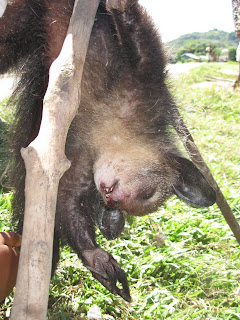
I thought last Thursday was going to be a lazy day, but it ended up being more like an anthropologists dream day--and I say that as someone with an Anthro degree, I am a culture nerd. :) I had laid my wet laundry out on the grass to dry in the sun and was just sitting down to study some French when one of the teens I know came by to tell me there was a no at the market. A what? A no. Eventually I figured out that she was talking about an aye-aye, known locally as eh-heh; the same as the word for no. (A lot of Malagasy words have multiple meanings.) The aye-aye is a strange animal, even for Madagascar: a lemur that looks like a cross between a raccoon and ET and has its own branch on the lemur family tree. It's famous for its extra-long middle finger, which allows it to dig for insects in trees and fill the same ecological niche that woodpeckers do in the US.

Before I got too excited, she added that it was a dead aye-aye. In part because they look so strange, the aye-aye is subject to superstition, and one of the forest towns had considered it a bad omen to see it near the village. Thay killed it and strung it up on a bamboo tripod at the crossroads to ward off bad luck. Apologies for the disturbing image, but here you go:


I had a (fairly civil) argument with the mayor about how no, they are not dangerous, and no, they do not attack people.

On a less gruesome note (since I didn't actually see this body), I got a very kind invitation to accompany a family to a ansaharana (sp?)--the local version of the famous Malagasy tradition of a bones-turning ceremony. It differs from the tradition in other parts of Madagascar (and as the explanations people were giving me were in Gasy, I'm not sure I have it all right), but basically, if a relative dies away from the ancestral village and the family cannot afford to ship the body back, they'll bury the person for 3-5 years, save up money, then dig up the bones, transport them back to the home village, and have a celebration. Most of it is family-only--days of sleepless singing and dancing--but on the last day the community visits for a big feast and speeches, which is what I was invited to. People were seated by town for the communal lunch, so through lunch women were yelling things like, "Tsaratanana! Karibo Sakafo!"--"People from NiceTown! Come eat!" After the speeches, I was invited to look in the family room, where all the furniture had been cleared out except for a small draped box/coffin on a table. It was surrounded by exhausted women sitting on floor mats.

Saturday was a different celebration altogether. A nearby town was celebrating the completion of 3 new school buildings, courtesy of the Japanese government and Aide et Action. After a lot of waiting, I got hustled up to a makeshift dais with a bunch of other VIPs (again, still don't think I belong in this category, but there you go). I was in the second row, but after the back of my chair fell through one of the plank gaps, they decided that was much too dangerous for me and made me change places with the vice-mayor and sit in the front row. The better to be stared at by over 500 people, joy. I did, however, get an amusing view of the kids, who spent the music breaks between speeches dancing like crazy in front of the loudspeakers. At least until it started raining--then the VIPs were talking to an empty field as the crowd retreated to the eaves of the newly completed school buildings. We watched the mayor cut the ribbon to one of the new buildings, then went in to admire the new facilities--basic concrete and wood, but sturdy. Two of the town leaders wrote a phrase on the blackboard in Gasy and French, and invited me to write the translation in English: School, the Gateway to Development. I should mention that these and other schools in the commune are all elementary or middle-school level; there isn't a high school in the commune (Am. equivalent of county).

On the way out, we passed the head and hooves of a bull that had been killed for the celebration. There you go, dead body number 3. I believe we ate him for lunch. (Locally-sourced food, anyone?)

This isn't a picture from the school opening, but from an environmental celebration I attended near Andapa awhile ago--I just though you might like a more cheerful image to end on than the dead bodies...:D